
Iran's Persian Gulf Strait Authority (PGSA) has declared the Strait of Hormuz closed due to 'recent illegal movements' by the US military, demanding transit permits, while the US Central Command (CENTCOM) insists the strait is 'open to all vessels' and vows to ensure 'freedom of navigation'.

India has once again raised alarms over the escalation in the security situation in the Red Sea area and strongly condemned Houthi strikes targeting Saudi Arabian territory, "including on civilians and economic assets."

On India's 80th Independence Day, a photo feature by Pravin Talan and Rupali Talan offers a compelling look into the challenging lives and rigorous training of India's armed and security forces, from the snow-capped mountains of Kashmir to the dense forests of Gadchiroli.

India has expressed serious concern over Houthi attacks on Saudi Arabia's civilian infrastructure and economic assets, stating that such actions threaten regional stability and freedom of navigation through the Bab-el-Mandeb strait. External Affairs Minister S Jaishankar discussed the issue with his Saudi counterpart. India also condemned the targeting of commercial shipping after an Indian national went missing following an attack on a Panama-flagged ship off Oman.

India's Indo-Pacific approach has traditionally emphasised strategic autonomy, ASEAN centrality, freedom of navigation, respect for international law and an inclusive regional order. Its growing defence and maritime partnerships with Australia, Japan, Indonesia, Vietnam and other Southeast Asian countries provide additional depth to this approach, point out Dr Kumar and Dr Jasmeet Kaur.

'1991 was an exceptional period in Indian history.' 'A big 400-volt shock was administered to the system, which was required. Today, we are in a much, much better position.'

New Delhi was told it had given something up; in reality it had stopped talking about it, notes Dr Abhishek Puri.

French President Emmanuel Macron on Monday announced that France and the United Kingdom will jointly lead a multinational initiative to restore free and secure navigation in the Strait of Hormuz amid uncertainty over the virtual control of the strategic waterway between the US and Iran.

It is too early to judge whether the CJP will become a consequential political movement or remain a moment of protest. Its significance will depend less on the size of crowds or the reach of online campaigns than on what follows when the initial excitement subsides, notes Manoj Mohanka.

The captain of the Pakistani naval ship was overconfident, reckless and professionally incompetent. He displayed false bravado and by his actions would have caused grievous injuries to his men onboard and severely damaged the ship. On the other hand the captain of INS Kolkata maintained his cool, composure, displayed excellent seamanship skills and maintained his course and speed to avoid a major catastrophe. Comparison of the two captains shows the levels in professional competence of the two navies which are miles apart, points out Commodore Venugopal Menon (retd).

India has reiterated its support for freedom of navigation and unimpeded commerce in the South China Sea, backing a 2016 international arbitral tribunal ruling that rejected China's extensive territorial claims. This stance aligns with a recent joint statement by the US, UK, and other nations, emphasising peaceful resolution of maritime disputes under UNCLOS.

India and Japan have signed a Memorandum of Arrangement on maritime security cooperation, committing to deepen defence ties and oppose unilateral actions that impede freedom of navigation in the Indo-Pacific, a move seen as directed at China's increasing military presence.

An Indian-American US Army surgeon in an innovative procedure removed a golf ball-sized tumour developed at the base of the brain by sending an endoscopic device through the patient's nose. Major Jagatkumar Patel, an anterior surgeon at the Walter Reed National Military Medical Centre near Washington, DC, along with neurosurgeon Army Lt Col Charles Miller, carried out the surgical procedure on Marine Corps Staff Sergeant Andy Archer, who lived with the tumour for 15 years.

US President Donald Trump has abruptly withdrawn from a peace deal with Iran, citing fresh intelligence of Iranian assaults on commercial vessels in the Strait of Hormuz. The decision, made just a fortnight after celebrating the deal, has led to a significant military escalation in the region, with the US launching extensive counter-operations against Iranian military infrastructure.

The US Central Command (CENTCOM) has launched extensive precision strikes across multiple Iranian military installations, deploying both one-way attack aerial and sea drones for the first time, to degrade Tehran's ability to disrupt international maritime trade in the Strait of Hormuz.

Prime Minister Narendra Modi and Indonesian President Prabowo Subianto have significantly advanced the India-Indonesia Comprehensive Strategic Partnership, securing crucial agreements on defence, critical minerals, and maritime security, including BrahMos missile supply and Sabang port development.

The United States conducted retaliatory strikes against Iran, targeting over 80 sites, after accusing Tehran of attacking commercial vessels in the Strait of Hormuz, while Iran condemned the US decision to revoke a temporary suspension of sanctions on Iranian oil sales.

Hours after US President Donald Trump on Wednesday said that the ceasefire deal with Iran was "over", the US President indicated that Washington could launch another round of strikes against the Islamic Republic, following strikes on Tuesday, saying it had already hit Tehran "very hard" and warning of further attacks.

A potential agreement between the United States and Iran, including a comprehensive ceasefire and gradual lifting of US sanctions, may be announced soon, according to reports. The agreement aims to de-escalate tensions and establish a framework for resolving disputes.

Conflicting reports emerge regarding the effectiveness of the US blockade on Iranian ports, with Iran claiming successful transit of vessels and the US asserting complete maritime dominance.

As many as 35 vessels, including cargo carriers and oil tankers, successfully navigated through the strategic maritime chokepoint of the Strait of Hormuz over the last 24 hours, according to Iran's state media reports citing a formal declaration by the Islamic Revolutionary Guard Corps (IRGC) Navy.

Addressing the 36th extraordinary session of the Council of the International Maritime Organisation (IMO) held on Thursday in London, the Indian envoy said, "India remains deeply concerned about the evolving situation and continues to call for de-escalation through dialogue and diplomacy, with utmost restraint and priority being given to the safety of civilians."

The US forces conducted strikes against Iran, on Friday, as a powerful response to Thursday's attack on a commercial ship that was transiting the Strait of Hormuz, said Central Command (CENTCOM) in a statement.

India and Australia have signed significant agreements covering civil nuclear energy, maritime security, and critical minerals, reinforcing their partnership's role in ensuring a peaceful Indo-Pacific. The pacts facilitate uranium supply from Australia to India and enhance cooperation in defence, cyber, and critical technologies.

The United States Central Command (CENTCOM) has confirmed the implementation of a naval blockade on Iranian ports, enforcing strict measures on vessels entering or departing, significantly escalating tensions between the two nations.

Former Central Command chief David H Petraeus suggests the US and Iran are likely to extend their ceasefire beyond the initial two-week period, citing willingness from both sides to continue negotiations.
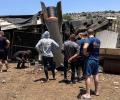
The Ministry of External Affairs (MEA) has confirmed the deaths of eight Indian nationals and one missing person in West Asia due to the ongoing conflict. The Indian government is providing support to affected families and facilitating the return of citizens from the region.

If Iran and Oman choose to charge a fee for rendering services to vessels using their territorial waters, so be it. The US is indulging in an irrationally self-destructive act, notes Ambassador M K Bhadrakumar.

Admiral Samuel J Paparo, Commander of the US Indo-Pacific Command, lauded India's military restraint during Operation Sindoor and emphasized the growing India-US defence partnership aimed at maintaining peace and security in the Indo-Pacific region.

The UN Security Council, with India's support, has adopted a resolution condemning Iran's attacks on Gulf Cooperation Council countries and Jordan, demanding an immediate cessation of hostilities and denouncing threats to the Strait of Hormuz.

British Prime Minister Keir Starmer contacted US President Donald Trump to express his relief following a shooting incident near the White House Correspondents Dinner. The leaders also discussed the need to restore freedom of navigation in the Strait of Hormuz.

In response to the Quad ministers' joint statement, China on Tuesday said it opposes the creation of exclusive 'small cliques' and 'bloc confrontation'.

Prime Minister Narendra Modi urged US President Donald Trump to prioritise the safety of Indian seafarers in the Strait of Hormuz during the implementation of Washington's proposed Iran peace deal, as both leaders focused on repairing strained bilateral relations at the G7 summit.

The US has threatened to prosecute those buying or selling sanctioned Iranian oil and has announced a blockade of the Strait of Hormuz after peace talks failed.

The US blockade on Iranian ports is aimed to curb Iranian energy exports, thereby crippling its economy to force Iran back to the negotiating table, points out Commodore Venugopal Menon (retd).

Iran has strongly criticised US plans to impose a blockade on its ports, warning that maritime security across the Persian Gulf region would be jeopardised if its own security is threatened.
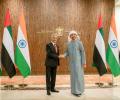
Frankly, was it really necessary in the middle of a fratricidal war for External Affairs Minister S Jaishankar to travel to Abu Dhabi for a one-on-one with the sheikh on April 12?Or, for National Security Advisor Ajit Doval to follow up on April 26? Or, for PM Narendra Modi to follow through today? There are no easy answers, notes Ambassador M K Bhadrakumar.

The Israeli Air Force (IAF) said it struck several targets in Tehran, Shiraz and Ahvaz simultaneously over the past 24 hours, targeting sites linked to Iran's ballistic missile programme, air defence systems and military headquarters.

The 'rescue' operation occurred within kilometres of Iran's underground tunnel complex at Isfahan, assessed by the IAEA and US intelligence as holding a substantial portion of the country's 60 per cent enriched uranium stockpile. Retired senior US military officers have highlighted that the mission's footprint -- hundreds of special operators, multiple heavy-lift aircraft deep inside Iran -- appears outsized for recovering a single airman. Prem Panicker continues his must read blog on the Iran War.

The ceasefire is still technically holding, to the extent that no overt hostilities have been reported yet, but the rhetoric has hardened dangerously. The week ahead will also clarify whether the Islamabad failure was a negotiating tactic or whether Washington has genuinely locked itself into a position from which the only exits are climb-down, escalation, or the slow bleed of a new status quo that nobody chose and nobody controls. Prem Panicker continues his must read blog on the Iran War.
